Hip pain on the outer side of your hip often points to hip bursitis, one of the most common causes of hip discomfort in adults. It can make everyday movements — climbing stairs, lying on your side, getting out of a chair — surprisingly painful. The good news: most cases improve with the right care.
This guide explains what hip bursitis is, why it happens, and how it’s treated. It also covers when your symptoms deserve a professional evaluation, because hip pain has several possible causes and shouldn’t automatically be assumed to be bursitis. If your pain is persistent or worsening, an orthopedic evaluation with Hasan Syed MD can help pinpoint the source and guide your recovery.
What Is Hip Bursitis?
Hip bursitis is inflammation of a bursa near the hip joint. A bursa (plural: bursae) is a small, fluid-filled sac that acts as a cushion between bone and soft tissue, reducing friction as muscles and tendons glide over bone. When a bursa becomes irritated or inflamed, that cushion swells and causes pain.
The hip has several bursae. Two are most often involved:
- Trochanteric bursa — sits over the greater trochanter, the bony point on the outer side of your hip. This is the most common site.
- Iliopsoas bursa — sits toward the front and inner part of the hip, near the groin.
Doctors now often describe outer-hip pain as greater trochanteric pain syndrome (GTPS), a broader term that includes bursitis along with irritation of nearby tendons. That distinction matters for treatment.
What Causes Hip Bursitis?
Hip bursitis is usually caused by repeated friction, pressure, or strain on the bursa. The tissue becomes inflamed when it’s overworked or irritated over time.
Common causes include:
- Repetitive motion — running, cycling, stair climbing, or standing for long periods.
- Overuse or sudden activity increases — ramping up exercise faster than your body adapts.
- Direct pressure — lying on one side for extended periods or a fall onto the hip.
- Tendon problems — weak or tight tendons around the hip that increase strain on the bursa.
- Poor movement mechanics — muscle imbalances, gait changes, or leg-length differences.
- Previous hip surgery or implants that alter how tissues move.
Less often, bursitis follows an infection (septic bursitis), which requires urgent medical care.
Common Symptoms of Hip Bursitis
The main symptom of hip bursitis is pain on the outer side of the hip. The discomfort often develops gradually and changes character over time.
Typical symptoms include:
- Aching or burning pain over the outer hip
- Pain that sharpens with activity, then settles into a dull ache
- Tenderness when you press on the outer hip
- Pain when lying on the affected side, often disrupting sleep
- Discomfort climbing stairs, standing up, or walking longer distances
Early on, the pain may feel sharp and intense. As it becomes chronic, it often turns into a broader ache that spreads down the outer thigh.
Where Does Hip Bursitis Hurt?
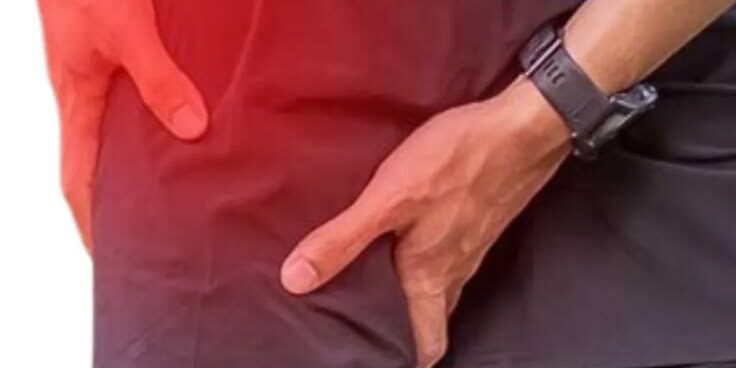
Hip bursitis usually hurts on the outer side of the hip, over the bony prominence. From there, pain can radiate down the outside of the thigh toward the knee.
Pain located deep in the groin is less typical of trochanteric bursitis and may suggest a problem inside the hip joint itself — such as arthritis or a labral tear. That’s one reason location alone can’t confirm a diagnosis.
Risk Factors for Hip Bursitis
Certain factors raise your risk of developing hip bursitis. Some you can change, and some you can’t.
- Age — it becomes more common in middle age and beyond.
- Sex — women are affected more often than men, partly due to hip anatomy.
- Repetitive or high-impact activity — especially running and sports with side-to-side motion.
- Weight — excess body weight increases load across the hip.
- Weak or tight hip muscles — particularly the gluteal muscles.
- Existing conditions — arthritis, tendon disease, or spine problems that change your gait.
Addressing modifiable factors, such as strengthening the hip and adjusting training load, lowers your chance of a flare-up.
How Is Hip Bursitis Diagnosed?
Hip bursitis is diagnosed mainly through a physical exam and your medical history. A doctor will ask about your symptoms, press on the outer hip to check for tenderness, and move your leg to see which positions trigger pain.
The diagnostic process usually follows these steps:
- Review your history — activity levels, when the pain started, and how it behaves.
- Examine the hip — checking for tenderness, range of motion, and pain patterns.
- Rule out other causes — this is called differential diagnosis, distinguishing bursitis from arthritis, tendon tears, or referred pain from the lower back.
- Order imaging if needed — X-rays can rule out arthritis or fractures, while ultrasound or MRI can show inflammation and tendon damage when the diagnosis is unclear.
Imaging isn’t always necessary, but it helps when symptoms are severe, unusual, or slow to improve.
Hip Bursitis Treatment Options
Most hip bursitis is treated without surgery. Treatment depends on the underlying cause and severity, and it usually starts with simple, conservative steps.
Common non-surgical treatments include:
- Rest and activity modification — pause the movements that trigger pain and return gradually.
- Ice — applying a cold pack to the outer hip can ease inflammation and discomfort.
- NSAIDs — nonsteroidal anti-inflammatory drugs (such as ibuprofen) may reduce pain and inflammation. These aren’t right for everyone; people with kidney disease, stomach ulcers, heart conditions, or certain other issues should check with a healthcare professional before using them.
- Physical therapy — targeted exercise to correct the mechanics driving your symptoms.
- Corticosteroid injections — an injection of anti-inflammatory medication near the bursa can provide relief when other measures aren’t enough. Effects vary and may be temporary, and injections are used selectively.
Surgery is rarely needed. It’s reserved for cases that don’t respond to months of appropriate conservative care.
Exercises and Physical Therapy for Hip Bursitis
Physical therapy is a cornerstone of lasting recovery from hip bursitis. It targets the muscle weakness and movement patterns that keep irritating the bursa, rather than just masking the pain.
A therapy program often focuses on:
- Strengthening the gluteal muscles to better support the hip
- Stretching tight tissues, including the iliotibial (IT) band and hip muscles
- Improving gait and posture to reduce strain on the outer hip
- Gradual return to activity with proper load management
Start new exercises under professional guidance. Pushing through sharp pain can slow your recovery.
Can Hip Bursitis Heal on Its Own?
Mild hip bursitis can improve on its own with rest and activity changes. If you reduce the aggravating movements early, inflammation often settles over a few weeks.
Recovery is faster and more reliable when you address the root cause — weak hip muscles or poor mechanics. Without that, symptoms tend to return. If self-care hasn’t helped after a couple of weeks, it’s time for an evaluation.
How Long Does Hip Bursitis Last?
Hip bursitis often improves within a few weeks with proper care. Mild, activity-related cases may settle in two to six weeks, while chronic or recurring cases can take several months to fully resolve.
Healing time depends on how long you’ve had symptoms, the underlying cause, and how consistently you follow treatment. Chronic cases usually need a structured physical therapy plan to break the cycle.
When Should You See a Doctor for Hip Bursitis?
You should see a doctor if hip pain is severe, persistent, worsening, or not improving with rest. A professional evaluation confirms the diagnosis and rules out more serious causes.
Seek prompt medical care if you notice:
- Fever, redness, or warmth over the hip — possible signs of infection
- Sudden, severe pain, especially after a fall
- Inability to bear weight or move the hip
- Numbness, tingling, or weakness in the leg
- Pain that keeps returning despite treatment
These warning signs point to conditions that need timely attention.
Hip Bursitis vs. Other Causes of Hip Pain
Hip bursitis is only one of many possible reasons for hip pain, and it’s often mistaken for other conditions. Getting the cause right shapes the treatment.
Conditions that can mimic or accompany hip bursitis:
- Hip osteoarthritis — typically causes deep groin pain and stiffness.
- Gluteal tendinopathy — tendon irritation that overlaps with GTPS.
- Labral tears — damage to the cartilage rim of the hip socket.
- Sciatica or lower-back problems — pain referred from the spine.
- Stress fractures — especially in runners or those with low bone density.
Because these conditions share symptoms, self-diagnosis is unreliable. An orthopedic specialist can tell them apart with an exam and, when needed, imaging.
Get an Expert Evaluation for Persistent Hip Pain
Lingering hip pain deserves a clear answer. If your outer hip pain is persistent, worsening, or affecting your sleep and daily activities, a specialist can identify the true cause and build a treatment plan suited to your needs. Schedule an evaluation with Hasan Syed MD to get an accurate diagnosis and evidence-based care for lasting relief.
Frequently Asked Questions About Hip Bursitis
What does hip bursitis feel like?
It usually feels like an aching or burning pain on the outer hip that sharpens with activity and often worsens when you lie on that side.
What is the fastest way to relieve hip bursitis?
Resting the hip, applying ice, and modifying aggravating activities offer the quickest early relief. A doctor may recommend NSAIDs or an injection for more stubborn pain.
Should I walk with hip bursitis?
Gentle movement is usually fine and even helpful, but avoid activities that sharply increase pain. Adjust your distance and pace as needed.
Can hip bursitis come back?
Yes. It often recurs if the underlying weakness or movement problem isn’t corrected, which is why physical therapy matters.
Is hip bursitis serious?
It’s usually not dangerous, but pain with fever, redness, or an inability to bear weight needs urgent medical attention.
Conclusion
Hip bursitis is a common and treatable cause of outer hip pain. Most people recover with rest, activity changes, physical therapy, and — when needed — targeted medical treatment. The key is addressing the root cause, not just the symptoms.
Because hip pain can stem from many conditions, an accurate diagnosis is the most important step toward relief. If your symptoms persist or worsen, reach out to a qualified specialist for a personalized evaluation.
This article is for general educational purposes and isn’t a substitute for professional medical advice.