That sharp ache at the back of your heel after a run — or the stiffness that greets you when you step out of bed — often points to Achilles tendonitis. It’s one of the most common overuse injuries affecting active adults, and it can slow you down whether you’re a weekend runner or simply chasing kids around the house. The good news: most cases improve with the right care and patience.
This guide explains what Achilles tendonitis is, why it happens, and how it’s treated. If your heel pain is persistent or worsening, a proper assessment from an orthopaedic specialist can pinpoint the cause and guide your recovery. Let’s start with the basics.
What Is Achilles Tendonitis?
Achilles tendonitis is pain and irritation of the Achilles tendon, the thick band that connects your calf muscles to your heel bone. This tendon sits at the back of your lower leg and ankle. It’s the largest and strongest tendon in your body, and it takes tremendous load every time you walk, run, or push off the ground.
When that tendon is overloaded, it becomes painful, tender, and sometimes swollen. Doctors increasingly call this Achilles tendinopathy — a broader term that describes the tendon’s condition. The reason is simple: many cases are not primarily an inflammatory process (tendon inflammation) but rather a breakdown in the tendon’s structure from repeated stress. So while “Achilles tendonitis” remains the common name, “tendinopathy” is often the more accurate one.
What Causes Achilles Tendonitis?
Achilles tendonitis is usually caused by overuse — repeated loading that outpaces the tendon’s ability to recover. The tendon gets stressed faster than it can repair itself, and pain follows.
Common contributing factors include:
- Sudden increases in activity — ramping up running, walking, or jumping too quickly
- Changes in training — new intensity, longer distances, or switching to harder or hilly surfaces
- Footwear — worn-out or unsupportive shoes that change how you push off
- Biomechanics — foot shape, gait patterns, or leg alignment that add strain
- Calf tightness or weakness — tight or weak calf muscles that transfer extra load to the tendon
- Age and general health — tendons become less flexible over time, and certain health conditions or medications can raise risk
Achilles tendonitis is a frequent sports injury, but you don’t have to be an athlete to develop it. A sudden burst of yard work or a new walking routine can trigger it too.
What Are the Symptoms of Achilles Tendonitis?
Achilles tendonitis feels like pain and stiffness at the back of the ankle or heel, often worse in the morning or after activity. The discomfort usually builds gradually rather than appearing all at once.
Typical symptoms include:
- Pain along the back of the heel or lower calf
- Morning stiffness that eases as you move
- Tenderness when you press on the tendon
- Swelling or a thickened area on the tendon (heel swelling)
- Pain that flares during or after exercise
- Difficulty walking, running, or rising onto your toes
Can you walk with Achilles tendonitis? Usually yes — many people keep walking with mild cases. Ongoing pain that changes how you move, though, is a signal to stop pushing through and get it checked.
Types of Achilles Tendonitis
Achilles tendonitis is grouped by where the problem sits along the tendon. Knowing the type helps guide treatment, because the two respond differently to certain exercises and footwear.
Insertional Achilles Tendinopathy
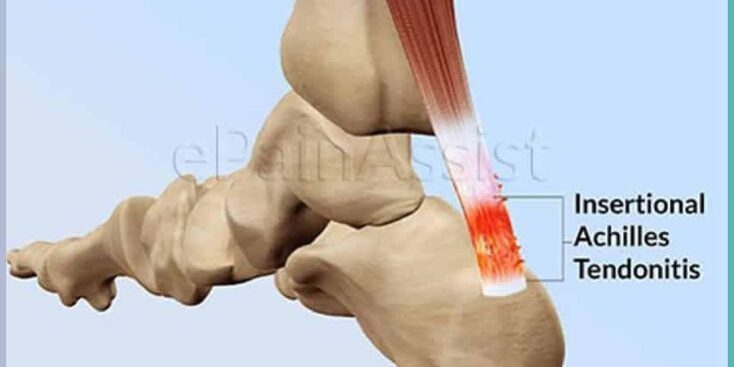
Insertional Achilles tendinopathy affects the point where the tendon attaches to the heel bone. Pain sits right at the back of the heel. Bone spurs or firm swelling can form here, and this type is often more sensitive to activities that stretch the tendon fully, like uphill walking.
Mid-Portion (Non-Insertional) Achilles Tendinopathy
Mid-portion Achilles tendinopathy affects the section of tendon a few centimeters above the heel bone. This is the more common type. You may notice a thickened, tender spot in the middle of the tendon.
The simple difference: insertional pain sits at the heel attachment, while mid-portion pain sits higher up the tendon.
How Is Achilles Tendonitis Diagnosed?
Achilles tendonitis is usually diagnosed through your medical history and a physical examination. Your doctor will ask about your symptoms, activity levels, and any recent changes in training or footwear. Then they’ll examine the tendon for tenderness, swelling, and thickening, and check your strength and range of motion.
Imaging isn’t always needed. When it is:
- Ultrasound can show tendon thickening or structural changes
- MRI may be used for detailed views or when other problems are suspected
Diagnosis also means ruling out other causes of heel pain, ankle pain, or calf pain — such as a partial tear, bursitis, or nerve-related issues. An accurate diagnosis is the foundation of an effective treatment plan.
How Is Achilles Tendonitis Treated?
Achilles tendonitis is treated primarily with activity changes and progressive rehabilitation, not with prolonged complete rest. The goal is to calm symptoms while gradually rebuilding the tendon’s strength.
Common evidence-based approaches include:
- Modify your activity — cut back on movements that spike pain while staying gently active
- Practice relative rest — reduce load without stopping movement entirely, since total rest can weaken the tendon
- Begin structured rehabilitation — reintroduce load in a controlled, progressive way
- Work with physiotherapy — a physiotherapist can guide strengthening and correct movement patterns
- Add strengthening exercises — progressive loading is a cornerstone of tendon recovery
- Adjust footwear or add heel lifts — supportive shoes or heel lifts can ease strain when clinically suitable
- Manage pain sensibly — over-the-counter options may help short-term; ask a pharmacist or doctor before using them
For persistent symptoms, other treatments may be considered, and your doctor can explain which are appropriate for your situation. Recovery takes time — often weeks to months — and varies from person to person. Consistency matters more than speed.
Exercises for Achilles Tendonitis
Progressive strengthening is one of the most effective parts of Achilles tendonitis recovery. Loading the tendon in a controlled, gradual way helps it adapt and rebuild — which is why rehabilitation focuses so heavily on it.
A common example is the controlled heel raise: slowly rising onto your toes and lowering back down, often progressing over time. Insertional and mid-portion tendinopathy sometimes call for different variations, which is one reason a tailored program works better than a generic one.
A few principles to keep in mind:
- Start gently and progress gradually
- Expect mild discomfort, not sharp or worsening pain
- Stay consistent rather than pushing hard occasionally
If an exercise significantly increases your symptoms, ease off and check in with a professional. A physiotherapist can design a program matched to your tendon and goals.
When Should You See a Doctor?
See a doctor for Achilles tendon pain that is persistent, worsening, or limiting your daily activities. Mild cases often settle with self-care, but some warning signs deserve professional attention.
Seek evaluation if you have:
- Pain lasting more than a few weeks despite rest and self-care
- Symptoms that keep getting worse
- Swelling, weakness, or trouble walking normally
- Pain that interferes with work, exercise, or sleep
A qualified professional can confirm the diagnosis and rule out more serious injury. Which brings us to an important distinction.
Achilles Tendonitis vs. Achilles Tendon Rupture
Achilles tendonitis is an overuse irritation, while an Achilles tendon rupture is a sudden tear of the tendon. Tendonitis builds gradually. A rupture happens in an instant — often during a quick push-off or jump.
Signs that may point to a rupture and need urgent medical assessment:
- Sudden, severe pain at the back of the ankle
- A popping or snapping sensation
- Significant weakness in the leg or foot
- Difficulty walking or pushing off the ground
A tendon rupture is a medical emergency in the sense that prompt evaluation improves outcomes. If you notice these signs, seek care right away rather than waiting.
How to Prevent Achilles Tendon Problems
You can lower your risk of Achilles tendonitis by managing how you load the tendon over time. Prevention comes down to smart training habits and consistent leg strength.
Practical steps:
- Increase activity gradually — avoid sudden jumps in distance, speed, or frequency
- Warm up properly — prepare your calves and ankles before intense activity
- Choose supportive footwear — replace worn shoes and match them to your activity
- Avoid abrupt training changes — ease into new surfaces or routines
- Strengthen your calves — strong calf and lower-leg muscles protect the tendon
- Allow recovery time — give your tendon rest days to adapt and repair
Build these habits into your routine, and you’ll protect the tendon that carries you through every step.
Take the Next Step Toward Recovery
Achilles tendonitis usually improves with the right combination of rest, rehabilitation, and patience — but you don’t have to guess your way through it. If your heel pain is persistent, worsening, severe, or limiting your daily life, a proper evaluation makes a real difference. Schedule an assessment with a qualified orthopaedic specialist who can diagnose the cause accurately and build a treatment plan suited to you. Your recovery starts with the right guidance.