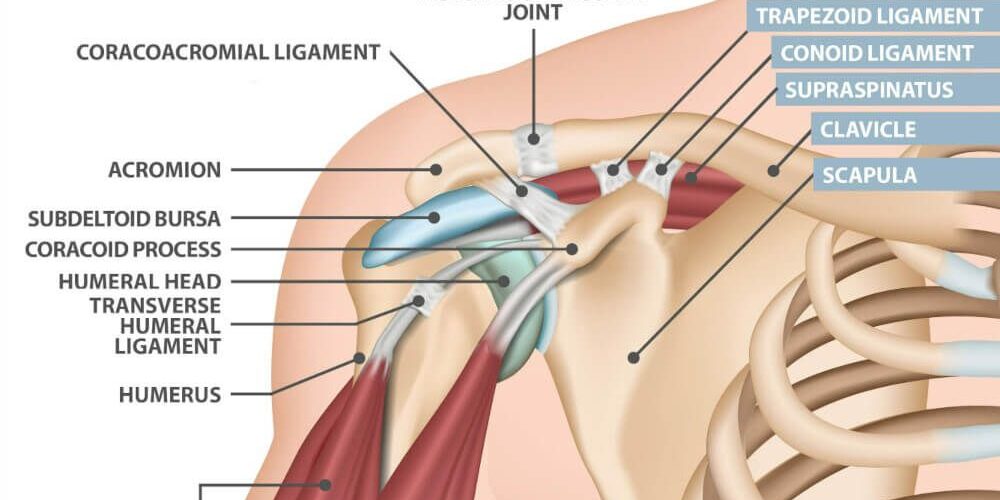
A shoulder separation is a common injury that happens when the ligaments connecting your collarbone to your shoulder blade stretch or tear. Many people confuse it with a shoulder dislocation, but they are not the same. A separation affects the AC joint on top of your shoulder, while a dislocation involves the ball-and-socket joint where your arm meets the shoulder. This difference matters because it changes how the injury is treated.
Most shoulder separations happen after a fall onto the shoulder or a hard hit during sports. Athletes in contact sports are especially at risk. Early diagnosis helps you avoid long-term pain and weakness. In this guide, you will learn the symptoms, how doctors diagnose it, your treatment choices, a realistic recovery timeline, and when surgery becomes necessary.
What Is a Shoulder Separation?
A shoulder separation is an injury to the acromioclavicular joint, often called the AC joint. This small but important joint sits at the top of your shoulder.
To understand the injury, it helps to know the anatomy:
- Clavicle (collarbone): The long bone running across the front of your shoulder.
- Acromion: The bony tip of your shoulder blade that meets the collarbone.
- Scapula (shoulder blade): The large, flat bone that forms the back of the shoulder.
- Shoulder ligaments: Strong bands of tissue that hold the collarbone and acromion together.
During an injury, a direct blow or fall pushes the shoulder blade down while the collarbone stays in place. This stretches or tears the ligaments holding the AC joint together. When these ligaments give way, the collarbone and acromion separate, which is why the injury earns its name.
Shoulder Separation vs Shoulder Dislocation
People often mix these two injuries up, but they affect different parts of the shoulder. The table below breaks down the key differences.
| Feature | Shoulder Separation | Shoulder Dislocation |
| Injured structure | AC joint ligaments (collarbone meets shoulder blade) | Ball-and-socket joint (arm bone leaves socket) |
| Pain location | Top of the shoulder | Front or deep inside the shoulder |
| Appearance | Bump on top of the shoulder | Arm looks out of place or deformed |
| Shoulder movement | Painful but arm stays in socket | Arm feels locked or stuck |
| Causes | Fall or direct blow to the shoulder | Fall on outstretched arm, collision |
| Treatment | Often non-surgical | Joint must be put back in place |
| Recovery | 2 to 12 weeks for most grades | Varies, often longer with therapy |
| Surgery likelihood | Usually only for high grades | Depends on damage and recurrence |
In short, a separation involves the joint on top of your shoulder, while a dislocation involves the main shoulder joint. If you are unsure which you have, our shoulder pain and shoulder instability explain both in more detail.
Common Causes of Shoulder Separation
A shoulder separation almost always follows a sudden, forceful event. The most common causes include:
- Falls onto the point of the shoulder
- Football tackles and hard collisions
- Hockey checks into the boards
- Cycling accidents that throw you over the handlebars
- Car accidents with sudden impact
- Skiing falls at high speed
- Rugby tackles and scrums
- Direct trauma from any blow to the top of the shoulder
- Workplace injuries such as falling from a ladder
Risk factors include playing contact sports, cycling without protective gear, and jobs that involve heights or heavy lifting. Younger, active adults and athletes face the highest risk.
Symptoms of Shoulder Separation
Symptoms usually appear right after the injury. Watch for these signs:
- Sudden pain at the top of the shoulder
- Swelling around the joint
- Bruising over the area
- A visible bump near the collarbone
- Tenderness when you touch the spot
- Limited shoulder motion
- Weakness in the arm
- A clicking or grinding feeling
- Sharp pain when lifting the arm
- Discomfort when sleeping on that side
The visible bump is one of the clearest signs. It happens when the collarbone lifts up after the ligaments tear.
Grades of Shoulder Separation (Rockwood Classification)
Orthopedic surgeons grade shoulder separations using the Rockwood Classification. This system runs from Grade I (mild) to Grade VI (severe). The grade guides treatment and recovery.
| Grade | Ligament Injury | Severity | Visible Deformity | Surgery Likelihood | Recovery Estimate |
| I | Stretched, not torn | Mild | None | Very unlikely | 1–2 weeks |
| II | Partial tear | Moderate | Small bump | Unlikely | 2–6 weeks |
| III | Complete tear | Significant | Clear bump | Sometimes | 6–12 weeks |
| IV | Complete tear, displaced backward | Severe | Marked deformity | Likely | 3–6 months |
| V | Complete tear, large gap | Severe | Large deformity | Likely | 3–6 months |
| VI | Complete tear, collarbone displaced downward | Rare, severe | Unusual deformity | Almost always | 3–6 months |
Grades I through III often heal without surgery. Grades IV, V, and VI usually need surgical repair because the bones move too far out of place.
How Orthopedic Surgeons Diagnose Shoulder Separation
Accurate diagnosis matters because the grade decides your treatment. A wrong call can lead to ongoing pain or a missed need for surgery. Here is how we evaluate the injury:
- Medical history: We ask how the injury happened and where it hurts.
- Physical examination: We check for the bump, tenderness, and range of motion.
- X-rays: These show the position of the collarbone and rule out a fracture.
- Stress X-rays: Taken while holding a light weight, these reveal hidden ligament damage.
- MRI: This gives a detailed look at the ligaments and soft tissue when needed.
- Ultrasound: Sometimes used to view the joint during movement.
Groups like the American Academy of Orthopaedic Surgeons (AAOS) and the Mayo Clinic agree that imaging confirms the grade and guides the right plan.
Treatment Options
Treatment depends on the grade of your injury, your activity level, and your personal goals. Most low-grade separations heal well without surgery.
Non-Surgical Treatment
For Grades I through III, conservative care usually works. Your plan may include:
- Rest to let the ligaments calm down
- Ice to reduce swelling in the first few days
- A sling to support the arm and ease pain
- NSAIDs such as ibuprofen to manage pain and swelling
- Physical therapy to rebuild strength and motion
- Activity modification to avoid stress on the joint
Most people regain full function within a few weeks. The bump may stay, but it rarely affects how the shoulder works.
Surgical Treatment
Surgery becomes necessary when the joint is badly displaced or symptoms do not improve. Candidates often include:
- People with high-grade injuries (Grades IV–VI)
- Athletes who need full overhead strength
- Patients with persistent instability or pain
Surgeons repair or reconstruct the torn ligaments to restore the joint’s position. Many procedures use arthroscopic techniques, which involve small incisions and faster healing. The American Shoulder and Elbow Surgeons (ASES) note that most patients return to their activities after proper rehab, though results depend on the injury and your effort during recovery.
Shoulder Separation Recovery Timeline
Recovery varies by grade, but this table gives a general guide for most patients.
| Time Frame | What to Expect |
| Week 1 | Rest, ice, sling, and pain control |
| Weeks 2–4 | Gentle motion begins, swelling fades |
| Weeks 4–8 | Strengthening exercises start |
| Weeks 8–12 | Most daily activities resume |
| 3–6 Months | Full strength returns for higher grades |
| Return to sports | When strength, motion, and stability are restored |
Always progress at the pace your doctor and therapist set. Rushing back too soon can set you back further.
Rehabilitation Exercises
A guided rehab program rebuilds strength and motion safely. Common exercises include:
- Pendulum exercises: Let your arm hang and swing gently in circles to ease the joint.
- Range-of-motion exercises: Restore movement before adding load.
- Scapular strengthening: Build the shoulder blade muscles that support the joint.
- Rotator cuff strengthening: Stabilize the shoulder with targeted moves.
- Resistance bands: Add light, controlled tension as you heal.
Do not start these on your own. Begin only after your physician clears you. The right timing protects the healing ligaments. Our physical therapy approach for the shoulder explains how a phased plan works.
Possible Complications
Most shoulder separations heal well, but problems can arise, especially with higher grades or delayed care. Watch for:
- Chronic pain at the top of the shoulder
- Arthritis in the AC joint over time
- A lasting cosmetic bump
- Weakness in the arm
- Instability in the joint
- Reduced performance in sports or work
Prompt treatment lowers these risks. Related conditions like rotator cuff tears, frozen shoulder, and AC joint injuries can also develop after shoulder trauma.
When Should You See an Orthopedic Surgeon?
Some symptoms need prompt evaluation. See an orthopedic shoulder specialist if you have:
- Severe pain that does not ease with rest
- A visible shoulder deformity or bump
- Inability to move your arm
- Numbness in the arm or hand
- Tingling down the arm
- Persistent symptoms lasting more than a couple of weeks
Early care prevents minor injuries from turning into chronic problems.
Ready for answers? Dr. Hasan Syed MD offers expert shoulder injury evaluation and both surgical and non-surgical AC joint injury treatment. Schedule an evaluation to get a clear diagnosis and a plan built around your goals.
Frequently Asked Questions
1. What is a shoulder separation?
A shoulder separation is an injury to the AC joint, where your collarbone meets your shoulder blade. It happens when the ligaments holding these bones together stretch or tear, usually after a fall or direct blow to the shoulder. It often causes pain and a visible bump on top.
2. Is shoulder separation the same as a dislocated shoulder?
No. A separation affects the AC joint on top of the shoulder. A dislocation involves the ball-and-socket joint where the arm bone leaves its socket. They have different symptoms, treatments, and recovery paths, so an accurate diagnosis from a specialist is important.
3. How long does shoulder separation take to heal?
Healing time depends on the grade. Mild Grade I injuries heal in one to two weeks. Grade II takes two to six weeks. Grade III may need six to twelve weeks. Higher grades that require surgery can take three to six months for full recovery.
4. Do all shoulder separations require surgery?
No. Most low-grade separations (Grades I–III) heal well with rest, a sling, and physical therapy. Surgery is usually reserved for high-grade injuries (Grades IV–VI), athletes who need full strength, or patients with ongoing pain and instability that does not improve.
5. Can you move your arm with a separated shoulder?
Yes, but it usually hurts. Many people can still move the arm, though lifting it or reaching overhead causes pain. With a dislocation, the arm often feels locked. If movement is severely limited, see a doctor to rule out other damage.
6. What is a Grade 3 shoulder separation?
A Grade 3 separation means the ligaments holding the AC joint are completely torn. This creates a noticeable bump on the shoulder. Many Grade 3 injuries heal with non-surgical care, though some patients, especially athletes, may benefit from surgery depending on their goals.
7. Can shoulder separation heal without surgery?
Yes. Grades I, II, and many Grade III separations heal without surgery. Rest, ice, a sling, anti-inflammatory medicine, and physical therapy usually restore strength and motion. Your orthopedic surgeon will recommend surgery only if the joint is badly displaced or symptoms persist.
8. What exercises help shoulder separation recovery?
Pendulum swings, range-of-motion moves, scapular strengthening, rotator cuff exercises, and light resistance band work all support recovery. Start only after your physician clears you, since early loading can harm healing ligaments. A physical therapist will guide your progression safely.
9. Is shoulder separation a medical emergency?
Most are not emergencies, but you should seek prompt care. Get urgent evaluation if you have severe deformity, numbness, tingling, or cannot move the arm at all. These signs may point to more serious damage that needs immediate attention.
10. When can I return to sports?
Return to sports once you regain full strength, motion, and joint stability. For mild injuries, this may take a few weeks. Higher grades or surgical cases may need three to six months. Always get medical clearance before returning to contact activities.
Key Takeaways
- A shoulder separation injures the AC joint where the collarbone meets the shoulder blade, and it differs from a dislocation.
- Falls and contact sports are the most common causes, putting athletes at high risk.
- The Rockwood Classification (Grades I–VI) guides treatment and recovery.
- Most low-grade injuries heal with rest, a sling, and physical therapy, while high-grade injuries may need surgery.
- Recovery ranges from a few weeks for mild cases to three to six months for severe ones.
- Never start rehab exercises without physician clearance.
- See an orthopedic shoulder specialist for severe pain, deformity, numbness, or persistent symptoms.