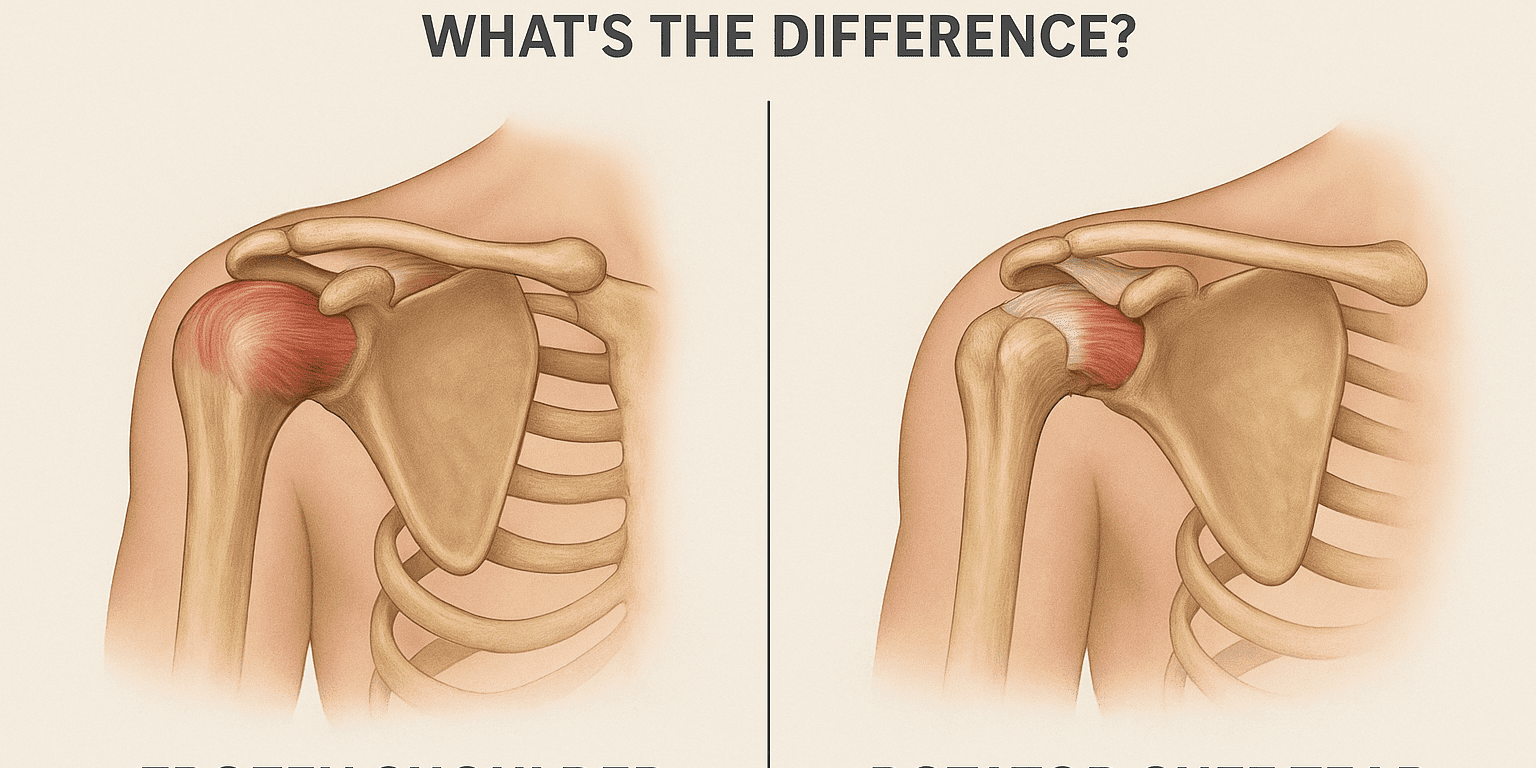
Frozen Shoulder vs Rotator Cuff Injury: What’s the Difference?
The main difference is simple. A frozen shoulder makes your joint stiff, so you cannot move it even with help. A rotator cuff injury weakens or tears the muscles around your shoulder, causing pain and weakness, but the joint can usually still move when someone moves it for you.
Both conditions cause shoulder pain. But they are not the same problem, and they need different treatment. Knowing which one you have helps you heal faster.
What Is Frozen Shoulder?
Frozen shoulder, also called adhesive capsulitis, happens when the tissue around your shoulder joint thickens and tightens. This tissue is called the joint capsule.
As it tightens, scar-like bands form. These bands make the joint stiff and hard to move. The stiffness builds slowly over months.
Frozen shoulder usually moves through three stages:
- Freezing stage: Pain increases and movement starts to shrink. Lasts 6 weeks to 9 months.
- Frozen stage: Pain may ease, but stiffness gets worse. Lasts 4 to 12 months.
- Thawing stage: Movement slowly returns. Lasts 6 months to 2 years.
What Is a Rotator Cuff Injury?
Your rotator cuff is a group of four muscles and their tendons. They hold your upper arm bone in the shoulder socket and help you lift and rotate your arm.
A rotator cuff injury happens when these tendons get irritated, strained, or torn. The damage can come on suddenly or build up over time.
Common types include:
- Tendinitis: The tendons become swollen and sore.
- Bursitis: The fluid-filled sac near the tendons becomes inflamed.
- Partial tear: The tendon is damaged but not fully torn.
- Full tear: The tendon rips completely away from the bone.
Key Differences Between Frozen Shoulder and Rotator Cuff Injury
The clearest way to tell them apart is a simple test: can someone else move your arm for you?
- Frozen shoulder: No. The joint is stuck. You cannot move it, and neither can anyone else. This is called loss of passive motion.
- Rotator cuff injury: Often yes. You may struggle to lift your arm on your own due to weakness, but another person can usually move it for you.
Here are the other big differences:
- Stiffness vs. weakness: Frozen shoulder causes stiffness. A rotator cuff tear causes weakness.
- Pain timing: Frozen shoulder pain is constant and worse at night. Rotator cuff pain often spikes when you lift or reach.
- Onset: Frozen shoulder builds slowly. A rotator cuff tear can happen suddenly after a fall or injury.
What Causes Each Condition?
Shoulder pain causes differ between these two problems.
Frozen Shoulder Causes
- Long periods of not moving the shoulder, such as after surgery or an injury
- Diabetes (a major risk factor)
- Thyroid problems
- Recovering from a stroke or heart disease
Rotator Cuff Injury Causes
- Repeating the same overhead motion, like painting or throwing
- A sudden fall or lifting something heavy
- Normal wear and tear as you age
- Bone spurs that rub against the tendon
Symptoms to Watch For
Both conditions share some signs. But the details set them apart.
Frozen Shoulder Symptoms
- Deep, aching pain in the shoulder
- Stiffness that limits movement in every direction
- Pain that gets worse at night
- Trouble with simple tasks like reaching behind your back
Rotator Cuff Tear Symptoms
- Weakness when lifting or rotating your arm
- A crackling feeling when you move the shoulder
- Pain when lying on the affected side
- Trouble lifting your arm overhead
Risk Factors
Some people face a higher chance of shoulder mobility problems.
Frozen shoulder risk factors:
- Age 40 to 60
- More common in women
- Diabetes or thyroid disease
- A recent period of keeping the arm still
Rotator cuff injury risk factors:
- Age over 60
- Jobs or sports with repeated overhead motion
- A history of shoulder injury
- Family history of shoulder problems
How Doctors Diagnose These Conditions
A correct diagnosis starts with a physical exam. Your doctor will move your arm and watch how it responds.
Common diagnosis methods include:
- Physical exam: Tests both active motion (you move) and passive motion (the doctor moves your arm).
- X-ray: Rules out arthritis or bone problems.
- MRI: Shows soft tissue, including torn tendons.
- Ultrasound: Gives a live view of the rotator cuff in motion.
Frozen shoulder often shows normal results on an MRI, since the problem is tightness rather than a tear. A rotator cuff tear usually shows up clearly on MRI or ultrasound.
Treatment Options
Most people improve without surgery. Your shoulder injury treatment depends on the cause and how severe it is.
Frozen Shoulder Treatment
- Physical therapy to slowly stretch the joint
- Anti-inflammatory medicine for pain
- Steroid injections to lower swelling
- Heat before stretching, ice after
- Surgery only in rare, stubborn cases
Rotator Cuff Injury Treatment
- Rest and activity changes
- Physical therapy to rebuild strength
- Anti-inflammatory medicine
- Steroid injections for pain relief
- Surgery to repair a full tear
Shoulder rehabilitation through guided exercises is key for both conditions. Skipping it often slows healing.
Recovery Time
Healing takes patience. Both conditions improve slowly.
- Frozen shoulder: Full recovery often takes 1 to 3 years, though many feel better sooner with therapy.
- Rotator cuff injury: Mild cases heal in a few weeks to months. After surgery, full recovery can take 4 to 6 months or more.
Prevention Tips
You can lower your risk of both problems with a few simple habits.
- Keep your shoulders moving, especially after an injury or surgery
- Stretch before exercise or repetitive work
- Strengthen the muscles around your shoulder
- Take breaks during overhead tasks
- Manage health conditions like diabetes that raise your risk
- See a doctor early if pain or stiffness starts
Comparison Table: Frozen Shoulder vs Rotator Cuff Injury
| Feature | Frozen Shoulder | Rotator Cuff Injury |
| Pain location | Deep, all around the shoulder joint | Front and side of the shoulder, may travel down the arm |
| Range of motion | Limited in all directions, even when moved by another person | Limited by weakness; often moves freely when moved by another person |
| Causes | Joint capsule tightening, diabetes, long periods of no movement | Overuse, sudden injury, age-related wear, bone spurs |
| Age group | Usually 40 to 60 | Usually over 60 |
| Diagnosis | Physical exam; MRI often looks normal | MRI or ultrasound shows the tear |
| Treatment | Stretching, physical therapy, injections | Rest, strengthening therapy, injections, surgery for tears |
| Recovery duration | 1 to 3 years | Weeks to months; 4 to 6 months after surgery |
Frequently Asked Questions
Can a rotator cuff injury be mistaken for frozen shoulder?
Yes. Both cause shoulder pain and trouble moving the arm, so they are easy to confuse. The key clue is movement. With frozen shoulder, the joint is stiff and stuck. With a rotator cuff injury, weakness limits movement, but the joint can usually still be moved by someone else.
How do I know if I have frozen shoulder or a torn rotator cuff?
Try this test. If someone else lifts your arm and it still will not move, you likely have frozen shoulder. If your arm moves when lifted by another person but feels weak when you try alone, a rotator cuff problem is more likely. Only a doctor can confirm with an exam and imaging.
Does frozen shoulder show on MRI?
Often it does not. Frozen shoulder is caused by tightening of the joint capsule, not a tear, so an MRI may look normal. Doctors usually diagnose it through a physical exam. An MRI is mainly used to rule out other problems, like a rotator cuff tear.
Which condition is more painful?
Pain varies by person. Frozen shoulder usually causes constant, deep pain that is worse at night and during the freezing stage. Rotator cuff pain tends to spike with movement, like lifting or reaching. Many people find frozen shoulder more painful day to day because the stiffness never fully eases.
Can frozen shoulder heal without surgery?
Yes. Most cases of frozen shoulder get better without surgery. Physical therapy, stretching, anti-inflammatory medicine, and steroid injections usually do the job. Recovery is slow and can take 1 to 3 years. Surgery is only considered when the shoulder stays stiff after other treatments fail.
When should I see a doctor?
See a doctor if shoulder pain lasts more than a few weeks, if you cannot lift your arm, or if pain wakes you at night. Sudden pain after a fall also needs quick care. Early treatment leads to better results and a faster recovery for both conditions.
Key Takeaways
- Frozen shoulder means stiffness; the joint is stuck and hard to move even with help.
- A rotator cuff injury means weakness; the arm can often be moved by someone else but feels weak on its own.
- Frozen shoulder builds slowly and is common between ages 40 and 60. Rotator cuff tears are more common after 60 and often follow injury or overuse.
- MRI usually shows a rotator cuff tear but often looks normal with frozen shoulder.
- Most people recover without surgery through physical therapy and shoulder rehabilitation.
- See a doctor early if pain lasts more than a few weeks or limits your daily life.
Conclusion
Frozen shoulder and rotator cuff injuries can feel alike, but they come from different problems. One stiffens the joint. The other weakens the muscles that hold it together. The simple test of whether your arm can be moved by someone else gives you a strong first clue.
Either way, you do not have to guess. A doctor can confirm the cause with an exam and imaging, then build a treatment plan that fits you. With the right care and a steady focus on shoulder rehabilitation, most people regain full movement and get back to the activities they enjoy.
If your shoulder pain is holding you back, reach out to a qualified healthcare provider. Early action protects your mobility and speeds up your recovery.